Most cars look fine from ten feet away. Under a proper inspection light, it’s a different story.
Swirl marks from automated car washes. Fine scratches from drive-through brushes. Water spot etching from Ontario road salt sitting on the paint through freeze-thaw cycles. Surface oxidation that’s turned a once-deep gloss into something flat and dull.
Paint correction is the process of removing all of that — mechanically, layer by layer — until what’s left is the original clear coat, restored as close to factory condition as the paint’s remaining thickness allows.
At MDM Auto Detail in Richmond Hill, paint correction is one of the services we’re most precise about. Here’s everything you need to know before booking.
What Paint Correction Actually Is
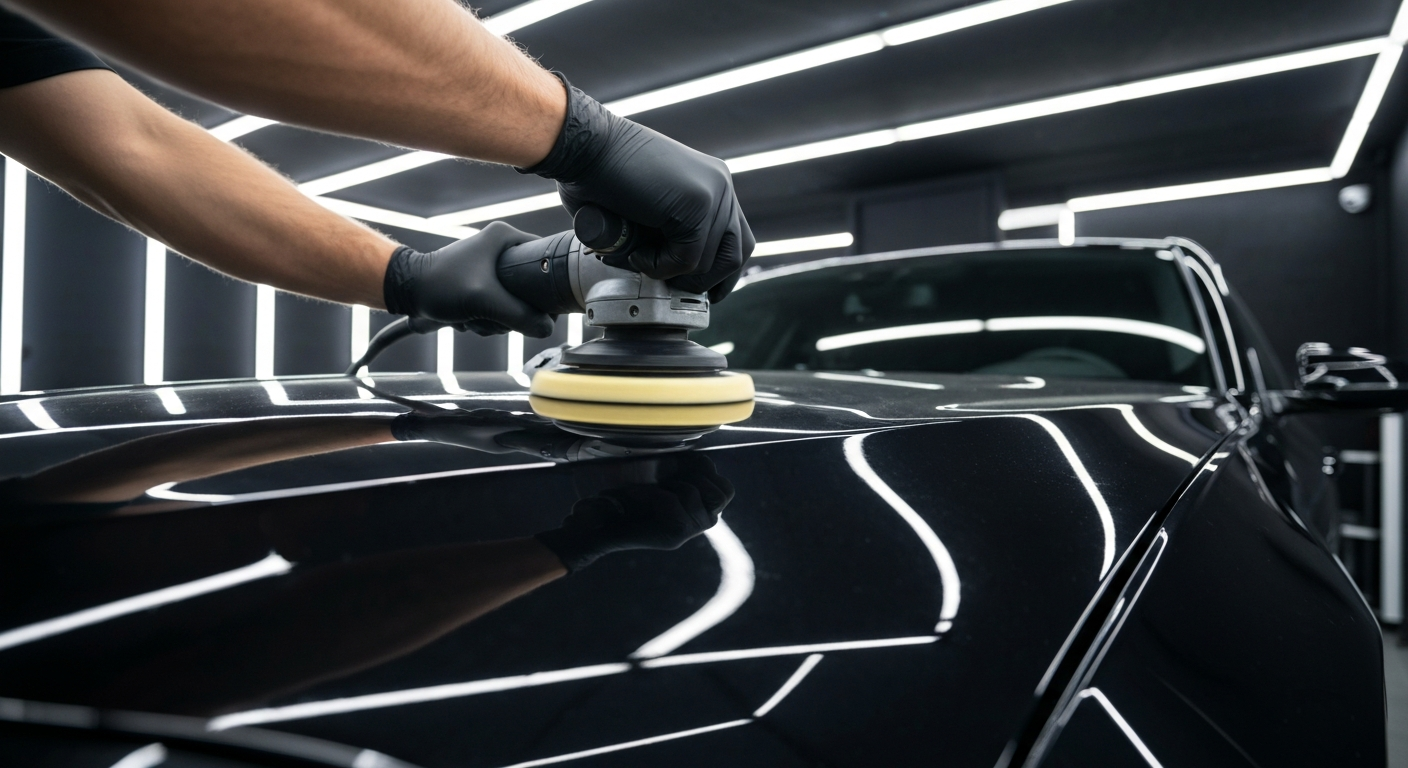
Paint correction is not a detail. It’s not a polish wipe-down. It’s a controlled, multi-stage process of using machine polishers, cutting compounds, and polishing pads to remove a micro-thin layer of clear coat — taking the defects with it, and levelling what remains into a flat, reflective surface.
The clear coat on your car is typically 50–100 microns thick. Every scratch, swirl, and water spot sits within the top portion of that layer. Paint correction removes just enough to get below the defect without burning through to the base coat underneath.
Done correctly, the results are dramatic. Done incorrectly — wrong pad, wrong compound, too much pressure, too much heat — you can thin the clear coat to the point where it needs respray.
This is why machine polishing should only be done by someone who understands paint thickness gauges, pad and compound pairing, and how to read a paint surface under proper lighting.
What Causes Paint Damage in Ontario
Richmond Hill and the GTA have specific conditions that accelerate paint damage compared to drier climates:
Automated car washes are the single biggest source of swirl marks on daily drivers. The brushes and rollers at drive-through washes trap grit and drag it across your paint in circular patterns. Over a few years of regular automated washing, the clear coat accumulates hundreds of micro-scratches that scatter light and kill gloss.
Road salt and winter grime — York Region salts roads aggressively from November through March. Salt-laden water sits in panel gaps, around mirrors, and on flat surfaces like the hood and roof. When it dries and refreezes, it etches into the clear coat. The longer it sits, the deeper it bites.
Drive-through brushes and squeegees — any brush or foam applicator that contacts multiple vehicles without being clean between passes transfers abrasive contamination directly onto your paint.
Improper hand washing technique — circular scrubbing with a dirty mitt, using dish soap, or drying with a terry cloth towel all introduce swirl marks. Most of the cars we see with significant swirling have been hand-washed, not machine-washed.
UV exposure — Ontario summers are stronger than most people expect. Extended UV exposure breaks down the clear coat’s protective resins over time, causing oxidation and a chalky, faded appearance — especially on horizontal surfaces like the hood, roof, and trunk.
The Three Stages of Paint Correction
Not every car needs the same level of correction. We assess paint condition under a 5-watt LED inspection light and a paint thickness gauge before recommending a stage — this tells us exactly how much clear coat remains and what we’re working with.
One-Stage Correction (Polish)
Best for: vehicles in good overall condition with light swirl marks, minor water spots, and surface haze. No deep scratches.
Process: a single pass with a machine polisher using a light finishing compound and polish pad. Removes the top layer of oxidation and fine surface defects. Restores clarity and gloss without cutting aggressively into the clear coat.
Result: 50–70% defect removal on light to moderately swirled paint. Significant gloss improvement. Ideal before ceramic coating on well-maintained vehicles. Typically 4–6 hours of shop time.
Two-Stage Correction (Compound + Polish)
Best for: vehicles with moderate swirl marks, light scratches, and more pronounced water spot etching — the most common condition we see on 3–7 year old daily drivers in the GTA.
Process: first pass with a cutting compound on a heavier pad to remove the defects. Second pass with a finer polish to refine the surface and eliminate any micro-marring left by the cutting stage.
Result: 80–90% defect removal. Dramatic transformation on paint that looked dull or hazy. The stage we recommend most frequently before ceramic coating or paint protection film. Typically 6–8 hours.
Three-Stage Correction (Heavy Cut + Compound + Polish)
Best for: vehicles with significant paint neglect — deep swirling, oxidation, heavy water spot etching, or light clear coat scratches. Common on vehicles that haven’t been properly cared for in years, or on older European cars with soft clear coats.
Process: three full machine polishing passes — an aggressive cutting stage, a medium compound stage to refine, and a finishing polish to maximise gloss.
Result: 90–95% defect removal where paint thickness allows. The most complete correction possible short of respraying. Typically 10–12 hours.
Paint Correction and Ceramic Coating — Why the Order Matters
We get asked frequently whether paint correction is necessary before ceramic coating. The answer is always the same: yes, if your paint has any visible defects.
Ceramic coating bonds chemically to your clear coat and adds gloss. That enhanced gloss amplifies everything underneath it — including every swirl mark, water spot, and scratch. Coating over defective paint doesn’t hide them. It makes them more visible.
Paint protection film has the same issue. Whatever is underneath the film at time of installation is locked in. Swirl marks visible before film installation are visible after — now permanently sealed under a protective layer you can’t remove without lifting the film.
The correct sequence is always:
- Paint inspection under LED lighting
- Paint correction to the appropriate stage
- Ceramic coating and / or paint protection film applied to perfected paint
We won’t apply a coating over paint that needs correction without flagging it first. It’s not the kind of result we’re willing to put our name behind.
What to Expect at MDM Auto
Every paint correction booking at our Richmond Hill shop starts the same way:
Paint inspection — we assess your paint under 5-watt LED lighting in a controlled environment. This reveals every swirl mark, scratch, water spot, and oxidation patch invisible under normal lighting. We also run a paint thickness gauge across the panels to confirm there’s sufficient clear coat to work with safely.
Stage recommendation — based on what we find, we tell you exactly which correction stage your paint needs and why. No upselling — if a one-stage polish gets you where you want to go, that’s what we recommend.
Machine polishing — performed panel by panel using the correct pad and compound combination for your specific paint type. European paint (BMW, Audi, Mercedes, Porsche) is often softer than Japanese or domestic paint and responds differently to compound aggressiveness — we adjust accordingly.
Post-correction inspection — every panel is checked again under inspection lighting before we consider the job complete. If a spot needs another pass, it gets one.
IPA wipe-down — if you’re going straight to ceramic coating or paint protection film, every panel is wiped with isopropyl alcohol to remove polish residue and oils before coating application begins.
Which Cars Benefit Most
We work primarily on European vehicles — BMWs, Audis, Mercedes-Benz, Porsches, Volkswagens — and the paint correction need is almost universal on cars older than 2–3 years.
BMW clear coats in particular are relatively soft compared to other manufacturers, which means they swirl more easily from improper washing but also respond extremely well to machine polishing — the gloss improvement on a corrected BMW is among the most dramatic we produce.
Any vehicle you’re planning to:
- Apply ceramic coating to
- Apply paint protection film to
- Prepare for sale to maximise presentation and value
- Simply restore to the condition it was in when you bought it
…is a candidate for paint correction.
Book Your Free Paint Inspection in Richmond Hill
If you’re not sure what stage your paint needs — or whether it needs correction at all — the right first step is a free paint inspection.
Bring your vehicle to MDM Auto at 11352 Yonge St, Unit 1, Richmond Hill, ON. We’ll put it under the inspection light, run the paint thickness gauge, and give you a straight assessment of what’s there and what’s needed.
No obligation. No pressure. Just an honest look at your paint.
Call us at +1 647-370-3443 or book online to set up your inspection.
We serve Richmond Hill, Vaughan, Markham, and the broader GTA.
Frequently Asked Questions
What is paint correction and how does it work?
Paint correction is the process of removing surface defects — swirl marks, fine scratches, water spots, and oxidation — from a car’s clear coat using machine polishers, cutting compounds, and polishing pads. A controlled micro-thin layer of clear coat is removed to level the surface below the defects, restoring gloss and clarity. It is not a surface product applied on top of the paint — it physically removes the damaged layer.
How long does paint correction take in Richmond Hill?
Depending on the stage required and the size of the vehicle, paint correction takes 4 to 12 hours of shop time. A one-stage polish on a well-maintained compact car runs 4–6 hours. A full three-stage correction on a large SUV or a heavily neglected vehicle can run 10–12 hours. We don’t rush the process — each panel is worked until it meets our standard under inspection lighting.
Will paint correction remove all scratches?
Paint correction removes defects that live within the clear coat layer. Deep scratches that have broken through the clear coat into the base coat or primer cannot be corrected by polishing — they require touch-up paint or a panel respray. During your free paint inspection, we identify which scratches fall into each category so there are no surprises.
How long does paint correction last?
Paint correction is permanent — the defects that are removed don’t come back on their own. However, new swirl marks and scratches will accumulate again over time from improper washing and normal driving. Protecting corrected paint with a ceramic coating or paint protection film significantly extends how long the corrected finish stays pristine. Without protection, most daily drivers show new swirling within 6–12 months depending on washing habits.
Does paint correction damage the clear coat?
When done correctly by an experienced technician with a paint thickness gauge, no. Paint correction removes only a controlled micro-thin layer — well within the safe working range of a standard clear coat. Done incorrectly — without checking paint thickness, using the wrong compound aggressiveness, or applying too much heat — it can thin the clear coat dangerously. This is why machine polishing should always be done by someone experienced with the specific paint type on your vehicle.
MDM Auto Detail — 11352 Yonge St, Unit 1, Richmond Hill, ON · +1 647-370-3443
Serving Richmond Hill, Vaughan, Markham, and the Greater Toronto Area